
The Autumn Reset: Preparing Professional Spaces for the Season Ahead
Autumn changes a workplace in ways that are easy to overlook.
The temperature falls. Daylight becomes shorter. Trees begin shedding leaves, rain becomes more frequent, and employees and visitors gradually spend more of their time indoors. None of these changes seems particularly dramatic on its own, yet together they alter the demands placed on a professional environment.
A facility that remained relatively easy to maintain throughout summer may suddenly contend with wet entryways, tracked-in soil, fallen leaves, increased dust, fingerprints on glass doors and heavier use of common areas.
Preparing a workplace for autumn, therefore, is not simply a matter of cleaning more. It is an opportunity to reconsider where attention is being directed and whether the existing routine still reflects the way the facility is actually being used.
The Entryway Becomes the First Line of Defense
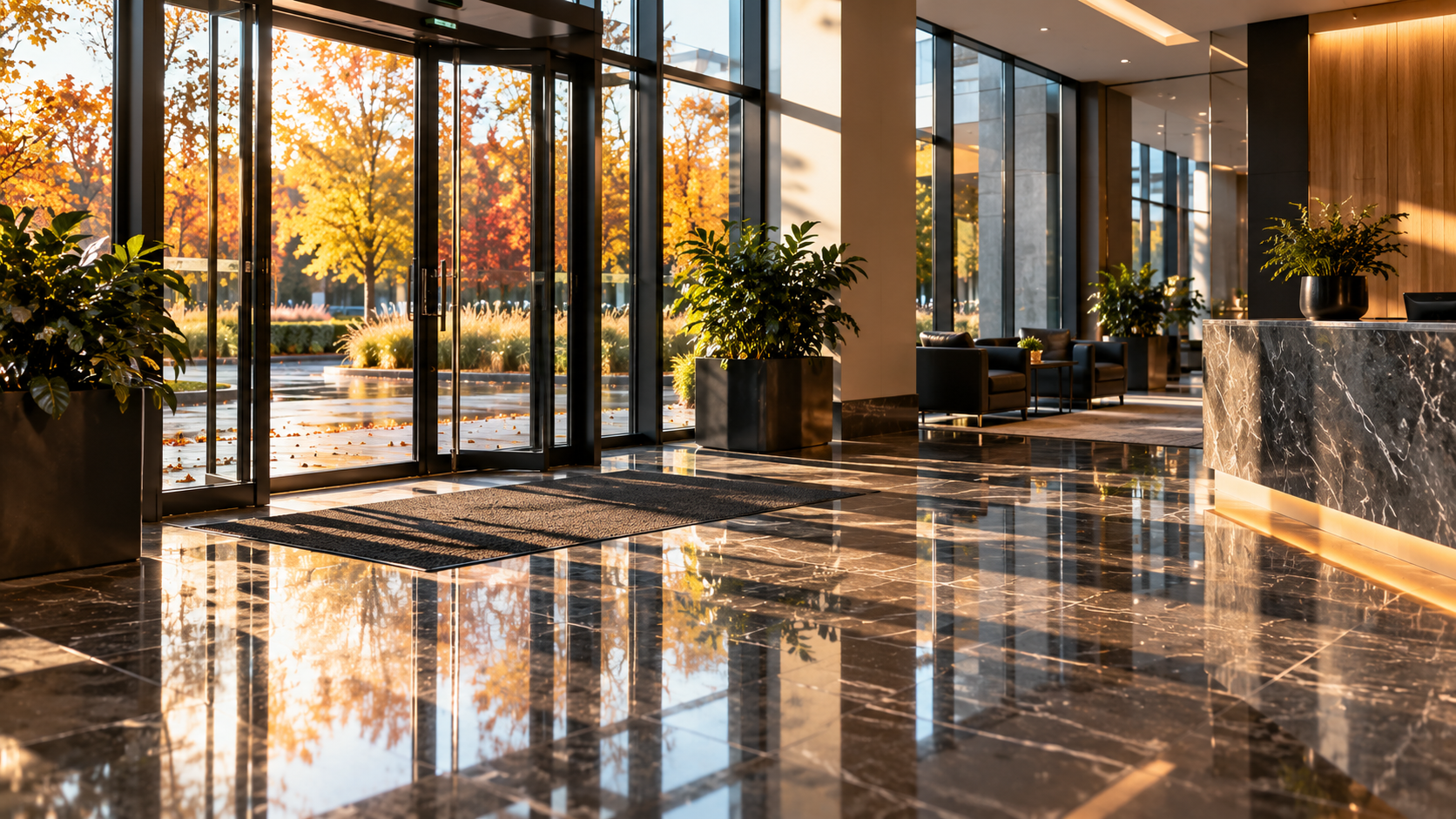
Few areas reveal the change of season faster than a building entrance.
Every person entering a facility carries a small portion of the outdoors with them. During dry weather, that may mean little more than dust. Autumn introduces leaves, moisture, soil and increasingly fine debris that can travel well beyond the doorway.
The entrance should therefore be considered more than a transitional space. It is the first line of defense for the rest of the facility.
Properly positioned entrance mats can capture a surprising amount of material before it reaches finished flooring. Those mats, however, must themselves be maintained. A saturated or debris-filled mat eventually stops solving the problem and begins contributing to it.
Hard flooring immediately surrounding entrances may also require greater attention as weather conditions change. Moisture and fine grit can dull the appearance of a floor and, depending upon the surface, contribute to premature wear.
There is also the matter of presentation.
The entrance is often the first physical interaction a client, employee or visitor has with an organization. Clean glass, orderly floors and a well-maintained reception area quietly establish expectations before anyone says a word.
Look Beyond What Appears Dirty
One of the peculiarities of seasonal change is that it can expose conditions that were present all along.
Autumn sunlight enters buildings at a lower angle than summer sunlight. Suddenly, fingerprints become visible on glass partitions. Dust appears along surfaces that looked perfectly acceptable several weeks earlier. Marks on polished floors become noticeable at particular times of day.
Changing light has not necessarily made the facility dirtier. It has simply made certain details easier to see.
That makes autumn an excellent time to examine areas that can disappear into an ordinary maintenance routine: glass doors and partitions, corners and edges, baseboards, ledges, vents, chair bases, door frames and other details that are rarely the most obvious part of a room.
This does not mean every surface requires intensive cleaning every visit.
It means that a thoughtful maintenance program occasionally needs to look beyond the routine.
There is an important distinction between a space that has been cleaned and a space that appears well maintained. The latter depends heavily upon the details.
Prepare for Increased Indoor Activity
As temperatures decline, activity naturally moves indoors.
Break rooms become busier. Conference rooms see more use. Reception areas accommodate visitors who might otherwise have remained outside. Doors and windows remain closed more frequently, and employees spend longer periods within shared environments.
Then comes the final quarter of the year.
Meetings, client visits, employee gatherings, holiday events and year-end activity can place additional pressure on areas that already receive substantial daily use.
This makes autumn a useful time to identify the spaces that matter most to the people using the facility.
Restrooms are an obvious example. So are kitchens and break rooms. But conference tables, door handles, reception counters, shared equipment and other high-contact surfaces deserve consideration as well.
Not every square foot of a building experiences the same level of use. Cleaning programs are more effective when they acknowledge that reality.
A lightly used private office and a heavily traveled reception area should not necessarily receive identical attention simply because they occupy the same building.
Reconsider the Cleaning Rhythm
Consistency is valuable, but consistency should not become rigidity.
A cleaning schedule established during one part of the year may need subtle adjustments during another.
Perhaps an entrance requires additional floor attention during periods of rain. Perhaps glass doors need to be addressed more frequently. Maybe a restroom that was adequate on its existing schedule begins experiencing heavier traffic.
The solution is not automatically to add hours or dramatically increase service.
Sometimes the answer is simply to redistribute attention.
A good maintenance plan should be capable of responding to the building rather than forcing the building into an inflexible checklist.
This is particularly important in commercial environments, where cleaning must coexist with normal operations. Employees still need to work. Customers still need access. Meetings still occur. Facilities cannot be treated as though they exist solely to be cleaned.
The most effective service often happens quietly around everything else.
Small Problems Are Easier to Address While They Are Still Small
Seasonal transitions are also an opportunity to identify maintenance concerns before winter magnifies them.
A little soil accumulating near an entrance is easier to manage before weeks of wet weather drive it farther into the building. A neglected floor edge is easier to correct before repeated traffic makes the condition more noticeable. A minor buildup in a restroom is easier to address before it becomes an obvious problem.
This principle extends beyond cleanliness.
Take a deliberate walk through the facility and view it as a visitor might.
Look through the front doors rather than merely walking through them. Sit in the reception area. Enter the conference room from the client’s side of the table. Look at the restroom counter from eye level. Notice the corners of the break room rather than only its countertops.
Familiarity has a peculiar way of making imperfections invisible.
Changing perspective can make them visible again.
A Seasonal Reset Does Not Need to Disrupt Operations
The phrase seasonal reset can sound considerably more dramatic than it needs to be.
For most professional environments, it should not mean shutting down operations for an exhaustive top-to-bottom cleaning.
Instead, think of it as an assessment.
What changed during the previous season?
Which areas are receiving more traffic?
What has gradually accumulated?
Which surfaces are beginning to show wear or buildup?
Are there areas that consistently require more attention than the current schedule provides?
And, equally important, are resources being spent cleaning areas more frequently than their actual use requires?
Those questions allow a facility to refine its maintenance program rather than simply adding more work.
Sometimes the most professional solution is not more cleaning. It is better-directed cleaning.
The Standard
A well-maintained professional environment rarely announces how much work went into maintaining it.
It simply feels right.
The entrance is orderly. Floors look cared for. Glass is clear. Restrooms are properly maintained. Common areas are ready to be used. Employees can concentrate on their work, and visitors are not distracted by the condition of the environment around them.
That quiet consistency is the objective.
Autumn provides a natural moment to examine a facility with fresh eyes—not because every workplace requires an elaborate seasonal overhaul, but because changing conditions provide an opportunity to reconsider what the space needs now.
Professional cleaning is ultimately about more than responding to what is visibly dirty.
It is about understanding how a space is used, anticipating how those demands change, and maintaining an environment that reflects the organization operating within it.
The season may change. The standard should not.